Coastal landforms
Explain cliff and headland change, trace sediment transport and distinguish beaches, spits and bars.
Start the lesson ↓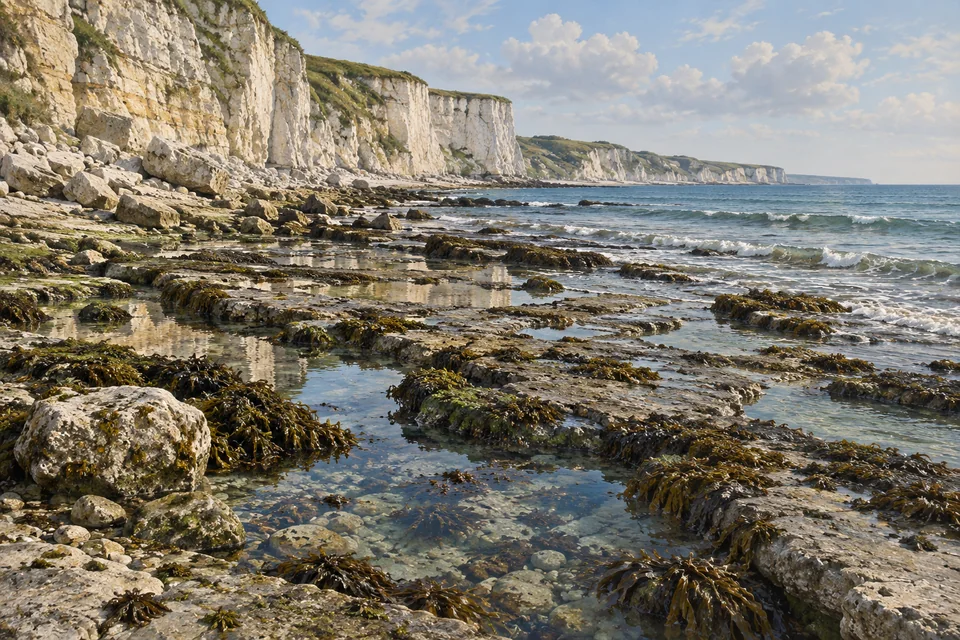
Part 1 of 3
Explain wave and rock interactions
Wave energy, water levels, rock resistance and structure affect erosion. Hydraulic action and abrasion can exploit weaknesses; weathering and mass movement can destabilise cliff material.
Differential erosion can create headlands and bays where rock types and structures permit. Wave refraction can concentrate energy around projecting headlands.
Worked example
A fictional storm water level rises by 1 m while the cliff foot lies 0.5 m above the earlier level. The changed water reach may expose the foot, though waves and tide require separate evidence.
Common mistake: Coastal erosion, weathering and mass movement have distinct mechanisms.
Part 2 of 3
Build an erosional landform sequence
Waves can enlarge weaknesses into caves, sometimes developing an arch through a headland. Collapse can leave a stack, with continued erosion eventually producing a stump.
Cliff retreat can leave a wave-cut platform where erosion cuts near the base and material above collapses. These sequences need suitable geology and water-level history.
Worked example
A fictional platform extends 60 m from the present cliff. Its width alone cannot establish a retreat date because water levels, geology and later erosion may have changed.
Common mistake: A landform’s apparent stage does not supply its age.
Part 3 of 3
Trace deposition and changing shorelines
Longshore transport can carry sediment along the coast. Deposition occurs where transport conditions change and sediment is available; spits may extend across a change in coastline direction.
Tidal or river flow can keep an opening beyond a spit. A bar can connect across a bay where conditions permit. Beaches and dunes involve distinct water and wind pathways.
Worked example
In a fictional beach budget 150 units enter and 130 leave. The +20 balance can build a store, but its position and shoreline response need additional surveys.
Common mistake: A positive sediment budget does not establish one uniform shoreline movement.
Try a different resource
Coastal change rates
Both surveys use the same defined cliff-top line and coordinate system. Movement is a net landward change over the whole period.
| Record | Value |
|---|---|
| Initial survey year | 2000 |
| Final survey year | 2015 |
| Landward movement of the same cliff-top line (m) | 30 |
Resource description
Fictional repeated cliff-top surveys
Write an explanation
Check your answer
- Connect conditions and process stages.
- Distinguish erosion from deposition.
- Use field, map or photographic evidence critically.
- Add a taught UK coastline landform example; management evidence alone leaves a gap.
Practise and review a written answer
Case studies
Medmerry: managed coastal realignment · Dawlish railway resilience
These pages provide selected evidence. Check the whole case requirement with your teacher.
Read further
- www.aqa.org.uk — source or course reference
- www.aqa.org.uk — source or course reference
- qualifications.pearson.com — source or course reference
- www.sqa.org.uk — source or course reference
- www.sqa.org.uk — source or course reference
- qualifications.pearson.com — source or course reference
- www.ocr.org.uk — source or course reference
- www.ocr.org.uk — source or course reference
- www.eduqas.co.uk — source or course reference
- www.eduqas.co.uk — source or course reference
Coastal processes and management · Storm surge and coastal inundation
Course links
AQA GCSE Geography · Pearson Edexcel GCSE Geography B · National 5 Geography · Higher Geography · Pearson Edexcel GCSE Geography A · OCR GCSE Geography A · OCR GCSE Geography B · Eduqas GCSE Geography A · Eduqas GCSE Geography B
Next topics
Coasts: sediment, change and management · Coastal systems: budgets, thresholds and pathways
Selected teaching sequence with fictional worked data. The linked case records supply bounded evidence; they do not satisfy every course case requirement.
Scottish links identify reusable parts of the topic. Scottish landforms, soil, weather and disease requirements need additional course-specific teaching.