Calculate river discharge
Fictional training exercise. A team measures a permitted shallow reach from a safe platform. The section is simplified as a rectangle.
Practise choosing sampling methods and explaining the limits of fieldwork data.
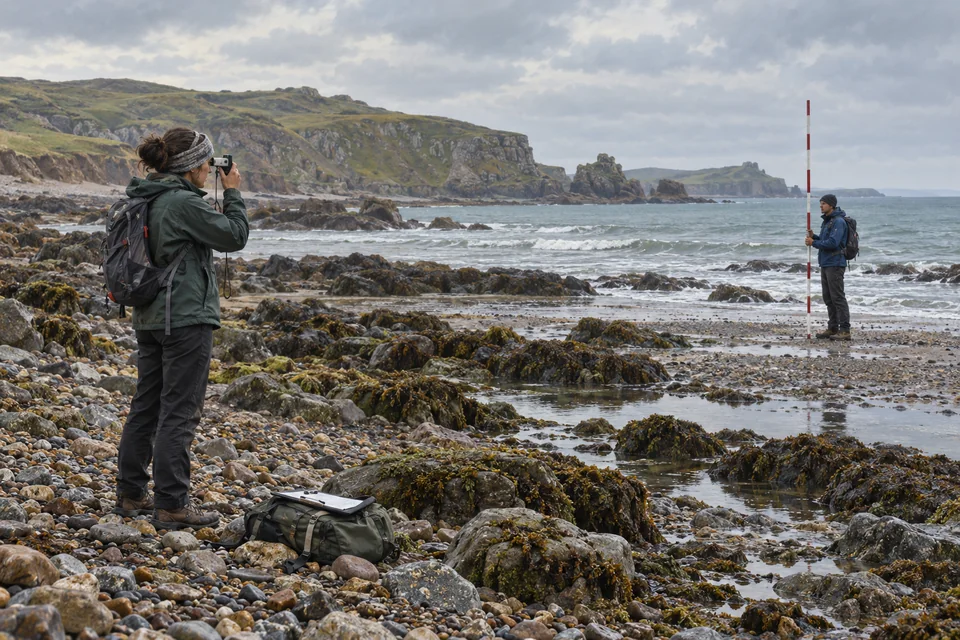
Consider consent, access and changing conditions throughout your enquiry.
Fictional training exercise. A team measures a permitted shallow reach from a safe platform. The section is simplified as a rectangle.
Fictional training exercise. A float is timed along the same 5 m reach four times. No student enters the water.
Fictional training exercise. Three zones have different surface materials. The group wants to compare all zones without choosing conspicuous stones.
Fictional training exercise. Heights come from a fictional surveyed profile above the same datum.
Fictional training exercise. The team compares pedestrian use at two sites, but the visits were at different times.
Fictional training exercise. A survey about a proposed town-centre cycle lane collects responses at a cycle shop.
Fictional training exercise. Two observers rate litter on a five-point scale. Higher scores mean less litter.
Fictional training exercise. Equal volumes of water are applied inside the same ring, under permission, in comparable safe sites.
Fictional training exercise. Sensors of the same model are placed at three sites. One is in direct sun against a dark wall.
Fictional training exercise. The question concerns vegetation change with distance from a regularly used footpath.
Fictional training exercise. A damaged counter failed at one of four sites.
Fictional training exercise. Two sources describe flood losses in fictional districts.
Fictional training exercise. Each pair represents a different fictional street measured during the same time window.
Fictional training exercise. A planned channel measurement follows heavy rain. A local warning is active.
Fictional general training exercise. Two sensors use the same shield and height, but the measurements were taken at different times. The team asks whether tree cover explains the temperature difference.
Fictional general training exercise. A fictional survey asks about cycle-lane support. Responses are voluntary and no names are recorded.
Fictional general training exercise. A permitted fictional exercise times floats along the same measured reach from a safe platform. The third observation records a possible obstruction. The data are for classroom methods training.
Fictional general training exercise. The team uses the same pebble-axis rule at each site. Site C has no valid reading. There is no evidence that its value was zero.
Fictional general training exercise. The marker and survey line are the same. The stated ±2 m is a conservative uncertainty bound for each reading, not a probability distribution.
Fictional general training exercise. Distances and widths are quantitative paired observations at four fictional sites. The small decrease at site 3 is part of the observations, not an error inserted to be removed.
Fictional general training exercise. The fictional observations compare two locations, but also compare different days and times. The team did not count at both sites in matching windows.
Fictional general training exercise. Two fictional situations arise during supervised methods training. An online task cannot approve a real site or replace a centre’s risk procedure.
No matches. Try a place, topic or skill.
Read the rules for NEA and AI assistance
Practise question focus, explanations and evidence with a short original activity.