Cold environments
Connect short growing seasons and frozen ground to ecosystems and decisions about infrastructure.
Start the lesson ↓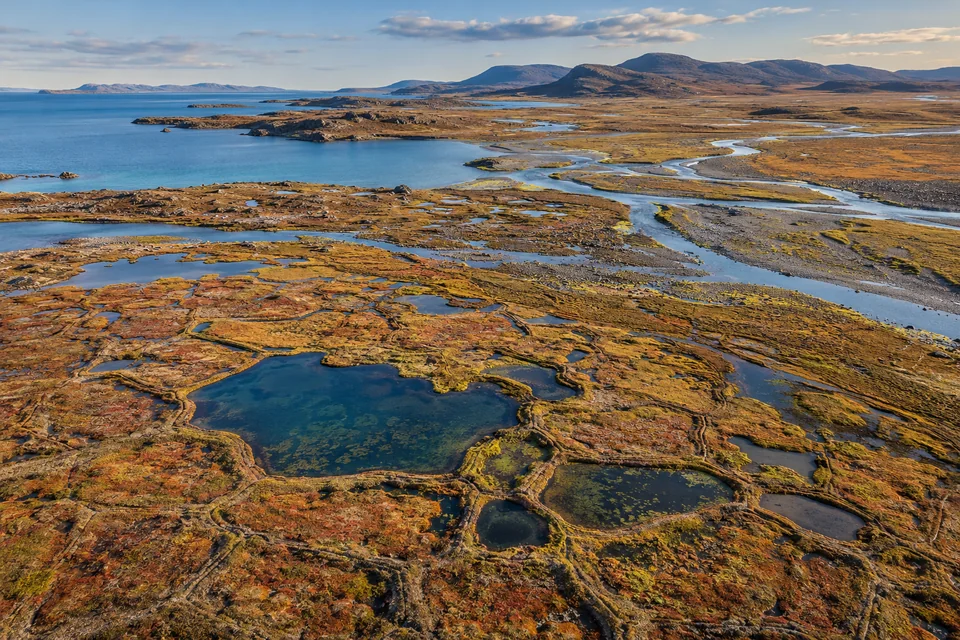
Part 1 of 3
Follow the seasonal constraints
Tundra and polar environments have different conditions. Short growing seasons and low temperatures limit biological activity. Permafrost is ground that remains at or below 0°C for at least two consecutive years.
The seasonally thawed active layer lies above permafrost where present. Drainage and vegetation depend on ground conditions; not all permafrost contains the same amount of ice.
Worked example
A fictional active layer deepens from 40 to 55 cm between comparable surveys: +15 cm. This does not establish that all underlying permafrost has disappeared.
Common mistake: Permafrost means a ground-temperature condition, not permanent surface snow.
Part 2 of 3
Explain infrastructure instability
Thawing ice-rich ground can settle or destabilise slopes. Roads, foundations and pipelines may then require repair or redesign. The effects depend on ice content, drainage and terrain.
Use Denali’s road intervention to trace a process–access–management chain. The case record does not represent all cold-region communities.
Worked example
A fictional road is open 120 days rather than 150: a 20% decrease. Lost opening days are an access measure, not a direct estimate of lost tourism income.
Common mistake: Construction completion and restored public access can have different dates.
Part 3 of 3
Balance use and conservation
Energy, minerals, fishing and tourism can bring income while altering habitats and access. Fragile soils and short growing seasons can slow recovery after disturbance.
Compare who decides, who benefits and who bears environmental costs. Conservation policies need implementation and monitoring alongside intentions.
Worked example
A fictional visitor cap falls from 1,000 to 800 visits weekly. The 20% reduction does not prove a 20% habitat recovery; recovery requires ecological measurements.
Common mistake: Fewer visitors can change income as well as environmental pressure.
Try a different resource
Source evaluation
A source can accurately describe its respondents while giving weak evidence about the wider population.
| Record | Detail |
|---|---|
| Study area | Fictional Eastbank town centre |
| Period | One Tuesday, 12:00–14:00, May 2025 |
| Recruitment | Volunteers passing one bus stop |
| Respondents | 240 |
| Reported satisfaction with buses | 48 |
Resource description
Fictional survey source record
Write an explanation
Check your answer
- Explain physical constraints and recovery times.
- Use a defined intervention as evidence.
- Consider access, livelihoods and ecological effects.
- Keep the full cold-environment case gap explicit.
Practise and review a written answer
Case studies
Permafrost thaw and Denali’s park road
These pages provide selected evidence. Check the whole case requirement with your teacher.
Read further
- www.aqa.org.uk — source or course reference
- www.aqa.org.uk — source or course reference
- qualifications.pearson.com — source or course reference
- www.sqa.org.uk — source or course reference
- www.ocr.org.uk — source or course reference
Adaptation to changing conditions · Ecosystem interdependence
Course links
AQA GCSE Geography · National 5 Geography · OCR GCSE Geography B
Next topics
Glacial landscapes: ice movement and inherited landforms · Climate change: evidence, causes and responses
Selected teaching sequence with fictional worked data. The linked case records supply bounded evidence; they do not satisfy every course case requirement.
Scottish links identify reusable parts of the topic. Scottish landforms, soil, weather and disease requirements need additional course-specific teaching.